

Boutonniere vs. Corsage: What's the Difference?
Boutonnieres and corsages look similar but differ in size, structure and placement. Here is who wears each, how to pin them, and how to coordinate both.
Two small arrangements, one persistent confusion. If you have ever pointed at a pin-on flower in a florist's workroom and called it a corsage — or quietly wondered why the groom's mother is wearing something so much larger than the groom — you are in good company. Couples ask about this constantly, usually a few weeks before the wedding, usually while holding three other decisions at once.
The difference comes down to scale, structure and placement. Boutonnieres are small and built for a lapel. Corsages are larger, more elaborate, and designed for a wrist or a dress. Get those two facts straight and the rest of the coordination becomes much easier, because you stop trying to make one piece do the job of the other.
The Short Answer
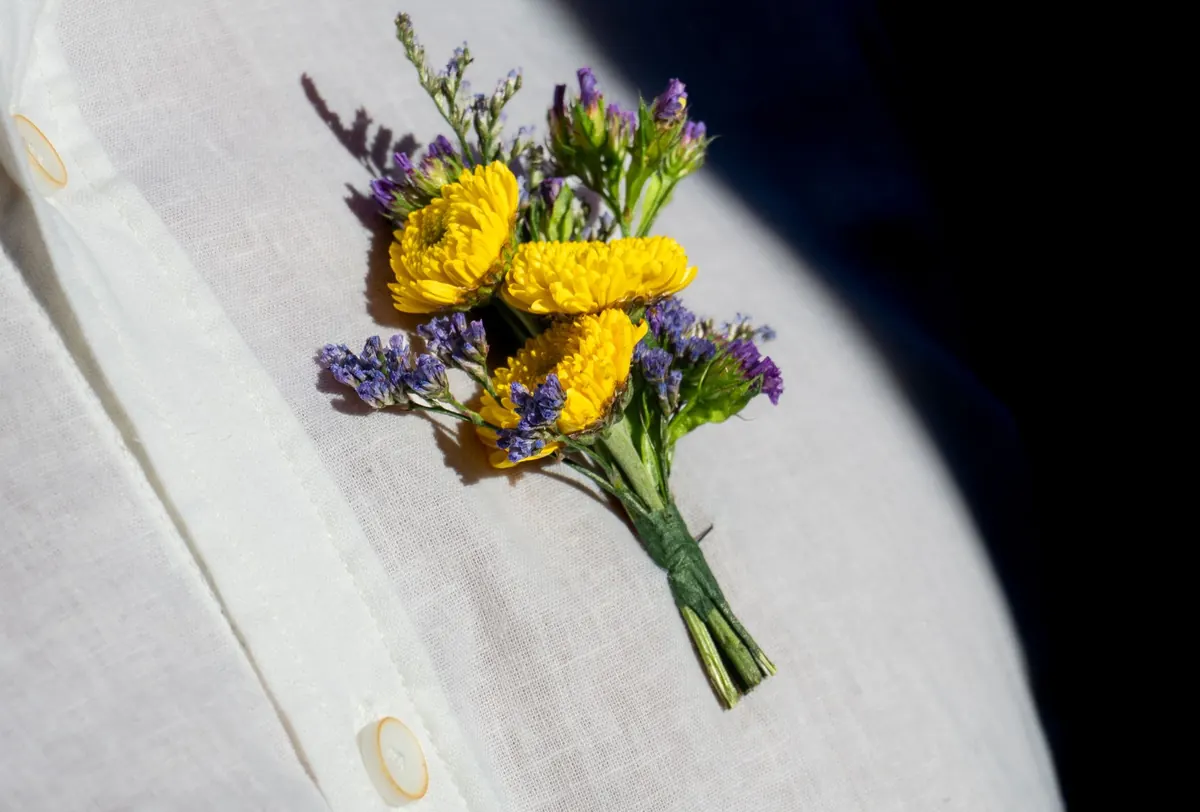
A boutonniere is a compact floral piece worn on a jacket lapel, traditionally by men. The word comes from the French for buttonhole, which tells you almost everything about its size: it should be small enough to sit above a pocket, light enough not to drag the fabric, and sturdy enough to survive a full day without water. Think one focal flower, two or three supporting stems, and a clean wrapped stem.
A corsage is a larger arrangement worn on the body — pinned to a dress or jacket, or mounted on a wristband. Historically it sat on the bodice, which is where the name comes from. Because it is bigger and heavier, it needs more structure: a proper base, a firm wristband if it is going on an arm, and stems that can handle being knocked against chairs, tables and hugging relatives.
So: same flowers, same colour story, different engineering. A boutonniere is jewellery. A corsage is a small accessory.
Who Wears What at a Wedding
The traditional split still works well, and most couples follow it, but it is a starting point rather than a rule. If a grandmother would rather have a wrist corsage than a pinned one, she should have it. If a woman is wearing a tailored suit, a boutonniere is the natural choice. The only real requirement is that everyone feels comfortable and looks intentional.
Here is the usual arrangement:
- Boutonnieres: groom, groomsmen, the couple's fathers, grandfathers, ushers, ring bearer, and often the officiant if they are a friend or family member.
- Corsages: both mothers, both grandmothers, readers, ceremony musicians, and any guest you want to honour publicly — a beloved aunt, a godmother, a close family friend.
- Bridesmaids: they usually carry bouquets, so a corsage is optional. A small wrist piece can be lovely for a flower girl who is too young to manage a bouquet.
- Anyone else: siblings not in the wedding party, a parent's partner, a carer who has travelled a long way. A single stem goes a long way.
Order a spare boutonniere and a spare corsage if your budget allows. Stems break, pins go missing, and someone always decides at the last minute that they would like one.
Where They Sit, and Why It Matters
The boutonniere
It goes on the left lapel, flower up, stem down, sitting roughly where a buttonhole would be — above the heart, which is the sentimental reason, and clear of the handshake, which is the practical one. Pin from the inside of the lapel so the fastener is hidden, and use two pins if the fabric is heavy or the piece has any weight to it. Ask your tailor or the shop where the suit was bought before you push a pin through a fine wool or a silk-blend jacket; some fabrics mark permanently.
Magnet-backed boutonnieres solve that problem entirely and are worth asking about for delicate suits. Just be aware that a magnet strong enough to hold through a thick lapel can also cling to nearby metal, so keep them away from keys and phones until they are on.
The corsage
A pinned corsage sits on the left side, near the shoulder or on the dress strap, angled so the flowers face outward and slightly up. It should not sit so high that it crowds the collarbone, and it should not be so heavy that it pulls the neckline out of shape. If the dress is sleeveless, strapless or made of anything delicate, a wrist corsage is almost always the better answer. It is also kinder to anyone who plans to spend the evening dancing or holding a glass.
Wrist corsages go on the left wrist. Check the band size before the wedding day — a band that is too tight is uncomfortable within an hour, and one that is too loose will slide around all night.
Flowers That Hold Up
A boutonniere or corsage has no water source, so durability matters more than it does in a bouquet. These are reliable choices:
- Spray roses and small garden roses — classic, hold their shape, available year round.
- Phalaenopsis orchids — exceptionally long-lasting and elegant against a dark suit.
- Carnations — unfashionably sturdy, and genuinely the toughest option on a hot day.
- Ranunculus and small calla lilies — softer and more romantic, though they bruise if handled roughly.
- Berries and texture — hypericum, brunia, thistle, waxflower, and herbs such as rosemary or olive foliage.
- Succulents — remarkably resilient, and many can be replanted afterwards as a keepsake.
Avoid anything fragile or heavy for a lapel: full peonies, large lilies, sweet peas, and tulips, which keep growing after cutting and will bend toward the nearest light source by the time the speeches start. Lily of the valley is beautiful and traditional but very delicate and expensive — better in a bouquet than on a shoulder.
Think about scent too. A corsage sits close to the face and is hugged repeatedly. Lavender and rosemary are lovely; a heavily perfumed lily is not, especially for anyone with allergies.
Coordinating Without Cloning
The most common mistake is treating the corsage as a scaled-up boutonniere. If both are built from the same three flowers in the same proportions, the corsage looks like a boutonniere that ate too much. Instead, share the palette and the key flower, then let the two pieces differ in everything else.
Say the bouquets are cream roses with olive foliage and a little dusty pink. The groom might wear one cream rose, a sprig of olive and a single hypericum berry. His mother's corsage uses the same cream roses, plus a dusty pink spray rose and a wider fan of olive, with a leaf or two to fill the shape. They read as a set, but each is built for its own scale.
Two practical notes. First, choose pieces that contrast with the clothing: a pale corsage disappears against a pale dress, so add a deeper leaf or berry for definition. Second, keep the strongest colour near the centre of each piece rather than scattered through it — the eye needs somewhere to land.
Ordering, Storage and the Day Itself
Finalise numbers about three weeks before the wedding, once you know who is actually attending and who is standing at the front. Confirm the delivery time for the morning of the ceremony, and ask how the pieces will arrive — boxed, labelled by name, and with pins already attached is the standard you want. Named boxes prevent the small chaos of eight identical boutonnieres on a table.
On the day, keep everything cool and out of direct sun. Store the pieces in a refrigerator if you can, but away from fruit — ripening fruit gives off ethylene, which shortens flower life. Do not put them in a freezer. A light mist of water on the foliage in the morning helps; soaking the flowers does not.
Pin people early, not in the last five minutes before the ceremony. Pinning takes longer than it looks, jackets come off, and someone will need a second attempt. Ask whoever is helping to check each piece is level and that no petals are crushed under a pin.
A Five-Minute Plan
- List everyone who will wear something, and mark each as boutonniere or corsage.
- Add one spare of each.
- Pick two or three flowers that hold up well and match your palette.
- Decide the pinning method for each corsage: pinned or wrist, based on the outfit.
- Give your florist names and outfits, not just numbers.
- Check the suit fabric before anyone reaches for a pin.
Do that, and the smallest arrangements of the day will quietly do their job: making the people closest to you feel publicly recognised, and making the photographs look as though someone thought about them. Which, of course, you did.