Bouquet Shapes Explained: Round, Cascade, Hand-Tied, and More
A practical guide to round, cascade, hand-tied, structured and loose bouquet shapes, with the occasions each one suits and checks to make before you commit.
Ask three florists to make a bouquet from the same buckets and you will get three different silhouettes. That is not indecision. Shape is a decision, and it changes how a bouquet reads from across a room, how it photographs, and how it feels in your hands after four hours of holding it. Some shapes are built for ceremony, others for the kitchen table on a Tuesday. Here is what each one is actually for.
Start With Where the Bouquet Will Be Seen
Before style names, answer three questions. Will it be carried or stand in a vase? How far away will most people be? And what will it be worn against — heavy silk, a linen suit, a wool coat?
A bouquet seen at arm's length needs detail: small blooms, texture, a clean edge. A bouquet seen from thirty rows back needs silhouette. The same generous handful of ranunculus that looks lovely in a close-up can vanish completely at the end of a long aisle.
Then there is the horizon line — where the top of the flowers sits on the body. Most people look best when the widest point lands between the waist and the lower ribs, with the blooms clearing the fabric rather than pressing into it. Hold any bouquet in front of a mirror at that height before you commit to it.
Round Bouquets
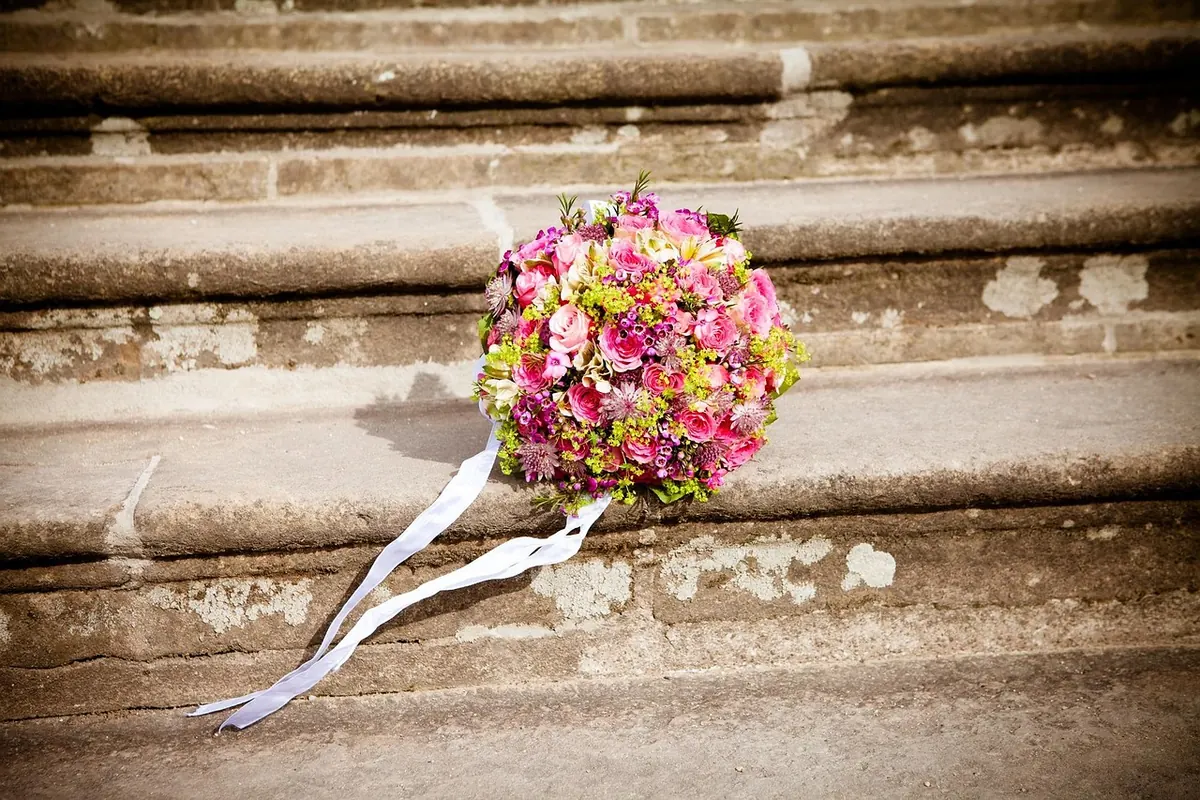
The round bouquet is a dome: densely packed, symmetrical, no obvious front or back. Blooms are usually arranged in a tight spiral or wired individually and set into a holder, so the finished shape is even on every side. Nothing should rattle when you turn it.
It is the most forgiving shape in the repertoire and the easiest to match to a dress or a suit, which is why it dominates bridesmaid work. Small round posies suit flower girls and mothers; a larger, looser dome works for a civil ceremony, an anniversary, or a birthday bunch that needs to look considered rather than casual.
What to ask for
If you have a small frame, ask for smaller blooms rather than fewer of them — spray roses, ranunculus, lisianthus, sweet peas — with a lower ratio of foliage underneath. A dense dome of large open roses can look heavy and slightly dated; the same shape in finer materials reads modern.
Cascade Bouquets
Cascades fall. They are wide and full at the top and narrow to a point below the hand, in a teardrop or shower line, and they are the most formal shape on this list. Traditional versions are wired and built into a holder so the trailing stems hold their position; looser modern versions rely on naturally trailing material such as amaranthus, jasmine vine, hanging orchids or delphinium.
This is a shape for a long aisle, a high ceiling, a church, a ballroom — and for a silhouette that benefits from a vertical line. It photographs beautifully from the waist up, which is where most ceremony photographs live.
It is also the heaviest bouquet you can reasonably carry. Ask how much it weighs when wet, how long you will be holding it, and where it can be set down during the reception. Plan the transport: a cascade crushed into a car seat on the way to the venue will not recover. Carry it low, with the tip falling below your hand, and let the stem ends rest against your hip rather than in front of your dress.
Hand-Tied Bouquets
Hand-tied is technically a technique rather than a shape — stems arranged in a spiral and tied with twine or ribbon, left visible rather than hidden in a holder — but it has become shorthand for a whole look: relaxed, garden-grown, slightly undone.
Well made, a hand-tied bouquet should stand on its own when you set it down, with the stems splaying slightly at the base like a sheaf. Held, it feels lighter than a wired bouquet of the same size because there is no mechanics, no soaked foam, no holder. That matters if you are carrying it for hours or travelling with it.
It suits garden and outdoor weddings, elopements, register office ceremonies, and everyday gifts where flowers are meant to go straight into a vase. Ask for the stems to be left reasonably long. After two or three days you can untie it, recut the ends and rearrange the same flowers in a wider vessel — the arrangement gets a second life, which is not true of a wired cascade.
Structured Shapes: Biedermeier, Posy, Pomander
Not everything has softened. Some shapes are deliberately geometric, and they are worth knowing by name if you want something crisp.
- Biedermeier — concentric rings of colour, built from the outside in, usually in two or three tones. Formal, almost architectural, and demanding in terms of flower quality. It suits hotel foyers, editorial work and anyone who wants a bouquet that looks composed rather than gathered.
- Posy — a small, tight round, often with a collar of foliage or a ribboned edge. The classic bridesmaid and flower girl shape, and a good choice when several bouquets need to look related without being identical.
- Pomander — a flower-covered sphere on a ribbon, carried by the loop or hung as decoration. Useful for children, for aisle markers, and for couples who would rather not carry anything loose.
- Sheaf or presentation bouquet — long stems gathered and bound, carried in the crook of the arm. Elegant with a simple dress and easier to hold than a heavy dome.
Loose, Asymmetric and Meadow-Style Bouquets
Here the shape is deliberately off-balance: one clear focal area, no mirror symmetry, taller material on one side, a few stems allowed to break the outline. Garden roses, grasses, umbellifers, stems with a natural bend.
These bouquets look effortless and are not. The proportions have to be controlled or the whole thing collapses into a bundle. When it works, it is the most personal shape on this list and the one most likely to look like it grew rather than was assembled.
Ask for "one focal point, no symmetry, some height on the left" rather than "meadow style" alone; the second phrase means something different to every florist. Be aware that a loose bouquet needs a suitable vase at home — dropped into a narrow-necked jug it will lose its shape within a day.
Matching Shape to Occasion
A quick reference, to be adjusted for dress, venue and season:
- Register office or elopement — a compact hand-tied or a small round posy. Light, easy to carry, good in close photographs.
- Traditional church or formal ceremony — cascade for a long aisle and a formal gown; a large structured round if you prefer symmetry to movement.
- Bridesmaids — small round posies in the same palette, varied slightly so they do not look like a matching set.
- Flower girl — pomander or a very small posy. Anything heavier will end up being carried by an adult.
- Anniversary, birthday, thank you — round or hand-tied. The hand-tied is better if the recipient will want to rearrange it.
- Sympathy — a simple round or a sheaf in quiet colours. Follow the family's wishes and any religious or cultural conventions; when in doubt, ask the funeral director or the family what is appropriate.
- Tables, installations and events — structured shapes hold their line for hours; loose arrangements need water and attention.
Practical Checks Before You Commit
Hold the sample, or a mock-up of the same size, before the day. Check three things while you are holding it.
- Weight. A bouquet feels very different after an hour. If it is uncomfortable in the shop, it will be unbearable by the speeches.
- The horizon line. Look in a full-length mirror. The flowers should sit where you want the eye to land, and the stems should not cut across the widest part of the dress.
- The photograph test. Have someone take one picture from close and one from across a room. If the shape disappears at distance, add height or width.
Then ask about logistics: how it travels, whether it needs water on the way, how to hold it so the front stays facing out, and what to do with it overnight. A bouquet kept cool, out of direct sun and with its stems in shallow water will look markedly better the next morning than one left on a radiator.
Finally, choose the shape you actually want to be holding. A cascade is magnificent and a hand-tied is easy, but the right answer is the one that feels natural in your hands when you catch sight of yourself in a window on the way out of the door.
Photo: Olessya / Pixabay